M6: a loose strand put -12 V on /WRREQ
M6 didn’t get far. The first time I powered the IIe with my board wired to the Liron card’s DB-19, U1 let the smoke out. The Apple was fine. The Liron card wasn’t. Its IWM can’t drive WR anymore, so the working UniDisk doesn’t show up on it either. M6 is paused until proper IDC breakouts arrive and the card is repaired.
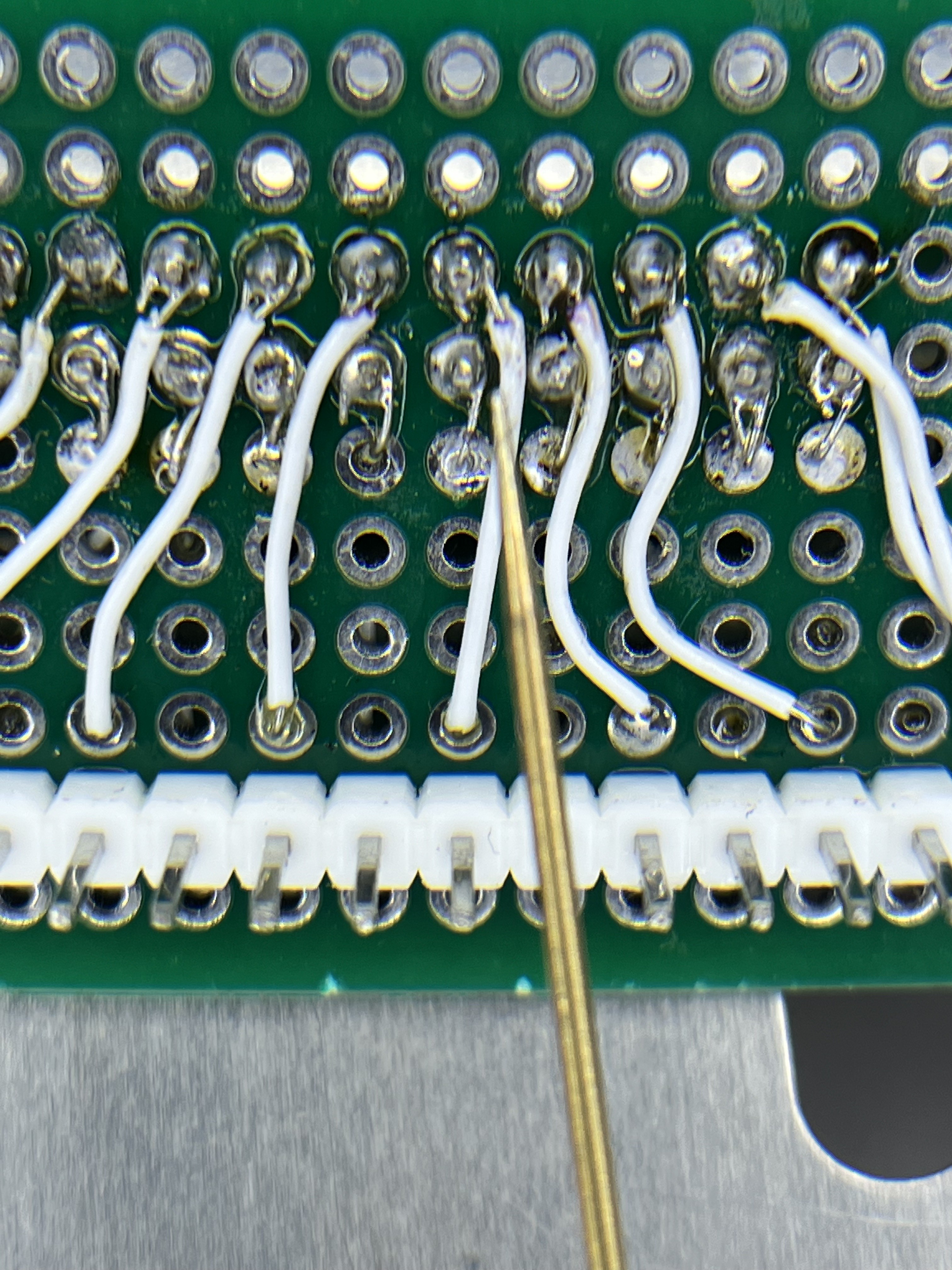
My adapter put the Apple’s rails between the signals
I made a DB-19 to breadboard adapter out of a ribbon and some perfboard. A ribbon crimped onto a DB connector alternates between the connector’s two rows, so along the strip the order goes 1, 11, 2, 12, and so on. That puts the Apple’s supply pins right between signal pins.
| Strip position | 8 | 9 | 10 | 11 | 12 | 13 | 14 | 15 | 16 |
|---|---|---|---|---|---|---|---|---|---|
| DB-19 pin | 14 | 5 | 15 | 6 | 16 | 7 | 17 | 8 | 18 |
| Signal | PH3 | -12V | /WRREQ | +5V | N/C | +12V | /HSTEN | +12V | RD |
My board runs on the bench supply, so those four rail positions stay unconnected. Before wiring anything I checked the strip with the IIe on and nothing else attached. It read -11.98 V, 4.80 V, 12.3 V and 12.3 V, all in the right places. PR#5 with no drive printed NO DEVICE CONNECTED, which is what the Liron ROM does when nothing answers INIT.
The host inputs (PH0-3, /WRREQ, /HSTEN, WR) went through the spare channels on U1, an SN74LVC8T245 that shifts the Apple’s 5 V down to 3.3 V. RD and ACK went out through a new one, U3.
A strand of wire bridged -12 V to /WRREQ
One stripped wire end on the adapter had a loose strand reaching the next pad, from position 9 (-12 V) to position 10 (/WRREQ). /WRREQ runs to U1’s 5 V side. -12 V on that pin pushed current through the input clamp until the chip latched up, and the package cracked across the die.
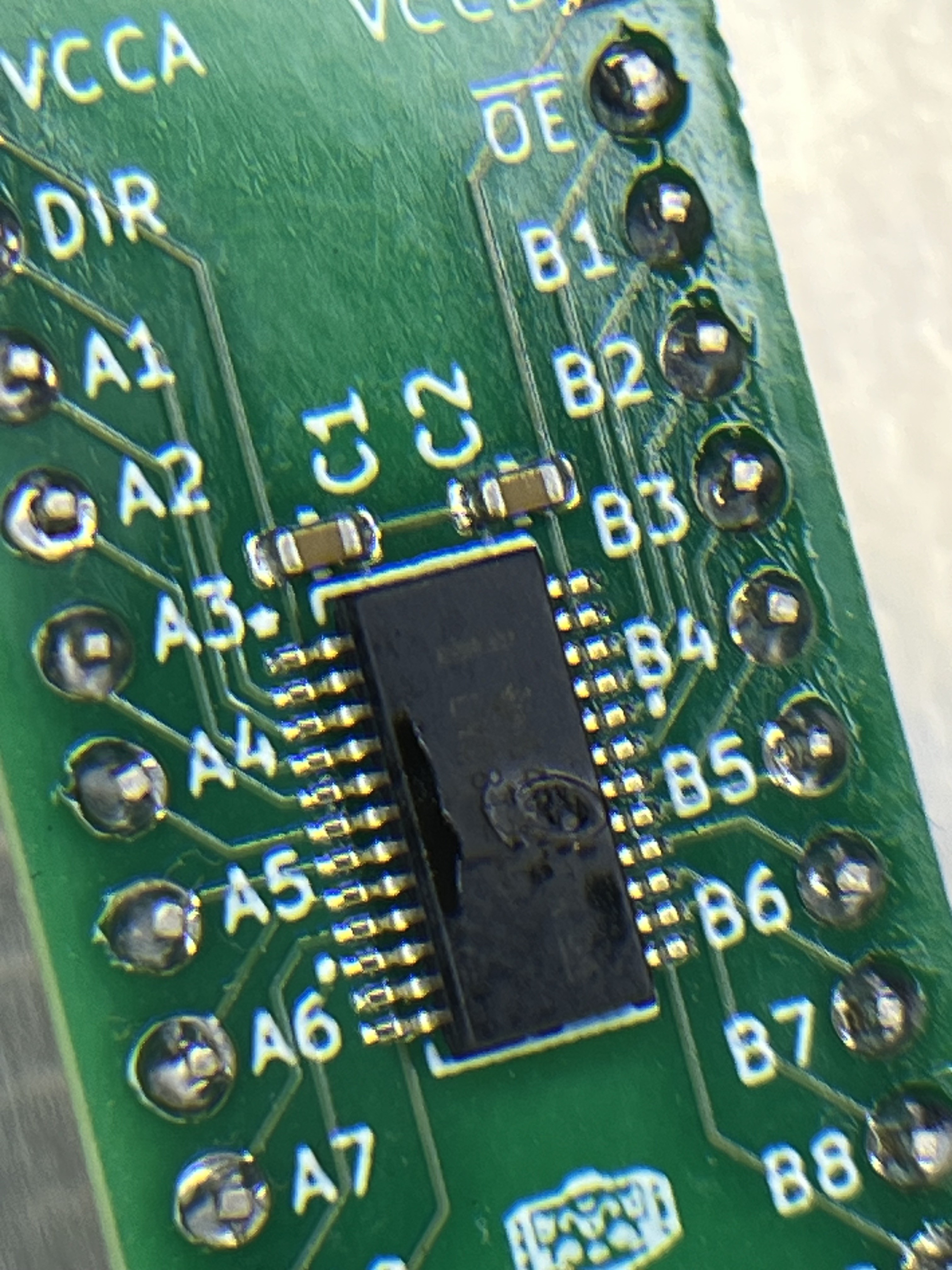
The rail voltage check couldn’t have caught it, because the rails were right. The fault was the row next to one. A continuity check between each rail position and its neighbors would have found the strand, and I skipped that one before turning the Apple on. I also had the pull-up resistors arched over the shifter module on long bare leads. They didn’t cause this, but they could have.
The Pico survived. Its inputs on GP2-8 and GP20 still follow the internal pull-up and pull-down. The replacement U1 is in.
Lesson for me: no more homemade connectors that carry live rails next to signals. Proper IDC breakouts are on order.
The Liron card lost WR
With the adapter out and the working UniDisk back on the Liron, the IIe booted normally but the drive didn’t show up. Its LED pulsed faintly and the mechanism made noise. I unplugged it right away.
Idle voltages at the card’s DB-19 didn’t tell me much without a before reading. PH0-3 sat around 1.3 V and /WRREQ around 1.0 V. Diode mode on the pulled card was clearer.
| DB-19 pin | Signal | Diode mode, red on pin 1 |
|---|---|---|
| 11-14 | PH0-PH3 | 0.825-0.834 V |
| 15 | /WRREQ | 0.925 V |
| 17 | /HSTEN | 0.751 V |
| 10 | ACK | 0.87 V |
| 18 | RD | 0.866 V |
| 19 | WR | 0 |
Every pin had its diode except WR. WR runs to pin 8 of the card’s IWM, WRDATA.
A dead drive board gave me the baseline
I don’t have a second Liron to compare against. The UniDisk’s own controller board, the IF-83, uses an IWM too, and both of my test drives have a dead IF-83 with the IWM still on it (344-0041-B). So I put the meter in diode mode on one of those IWMs, red lead on pin 14 (GND), and did the same on the Liron’s.
| IWM pin | Signal | Dead IF-83 drive board | Liron card |
|---|---|---|---|
| 13 | D3 | 0.588 V | 0.468 V |
| 12 | D2 | 0.587 V | 0.468 V |
| 11 | D1 | 0.588 V | 0.468 V |
| 10 | D0 | 0.588 V | 0.467 V |
| 9 | /WRREQ | 0.812 V | 0.927 V |
| 8 | WRDATA | 0.814 V | 0 |
| 7 | /DEV | 0.679 V | 0.513 V |
The Liron’s data pins all read about 0.12 V lower than the drive board’s. They shift together, so I put that down to what else sits on each board’s bus. Pin 8 is the only one with nothing there.
Pin 8 sits right next to pin 9, /WRREQ, which is where the -12 V came in. Without WR the card can’t send a single command packet, so the UniDisk never gets its INIT.
Those drive boards also make the repair plan: the Liron gets a donor IWM. They’re dead for reasons I haven’t tracked down, so the donor gets checked pin by pin before it goes in.
If a Liron card (the Apple UniDisk 3.5 controller) stops finding its drive after a wiring accident, put the meter in diode mode on DB-19 pin 19 against pin 1, and compare IWM pin 8 with a known good IWM.
ACK rides U3 with RD
The original plan had a 74LVC1G07 open-drain buffer for ACK. I didn’t have one, and the Byte Hamr FPGA side treats ACK as a plain input with a pull-up anyway. The original drive turns on its RD and ACK drivers together with one bus-enable bit and releases both otherwise. So ACK shares U3 with RD and the same /OE, with a 10k pull-up to 5 V on my side.
The first PR#5 with no drive hung while a meter probe sat on the adapter, and a cold reboot cleared it. My guess is ACK floating with nothing pulling it up, so the pull-up stays.
Still open
- Swap a donor IWM into the Liron. Confirm the part number matches and whether it’s socketed, and diode-check the donor’s output pins first.
- Scope
PR#5on the repaired card with no drive attached, looking for the reset pulse on PH0 and PH2 and FM on WR. Then a write test with the working UniDisk. - Rebuild the host side on the IDC breakouts. Rail-to-neighbor continuity checks before any Apple power, and a low current limit on the bench supply for the first connect.
- M6 itself: SmartPort on the RP2350, serving a RAM disk.